Adult orthodontics at our Royal Palm Beach office means braces or clear aligners for grown-ups, planned and checked at every visit by Board-Certified Orthodontist Dr. Jonathan Murray. It’s for adults whose teeth moved after braces years ago, adults who never had treatment, and adults whose bite is wearing teeth down or making chewing harder.
About half of our patients are adults. You’ll find Murray Orthodontics at 685 Royal Palm Beach Blvd, Suite 201.
Metal braces cost $3,000 to $7,000. Clear braces, Iconix braces, Invisalign and Spark aligners cost $3,500 to $7,500. Your first visit is a free consultation, and you leave it with your full cost in writing.
The thing adults tell us most often afterward is that they wish they’d come in sooner.
or call (561) 795-7707
Why adults in Royal Palm Beach come in for treatment
Most adults come in for one of five reasons. Many have more than one.
Teeth that moved after braces as a teen. Teeth keep moving for life, and crowding often comes back once a retainer stops getting worn. A second round is usually shorter and simpler than the first.
Crowding that has gotten worse. Teeth drift over the years, and crowding often shows up first in the lower front teeth. Overlapping teeth are also harder to brush and floss. More on crooked teeth treatment.
Gaps. Spaces between teeth can trap food and change how your teeth meet. Our page on gap teeth explains the causes.
A bite that doesn’t work right. Front teeth that don’t touch (open bite), lower teeth in front of the upper teeth (underbite), or upper teeth sitting inside the lower ones (crossbite). An uneven bite can wear some teeth faster than others and make your jaw work harder than it should.
You never had the chance. Maybe braces weren’t in the budget growing up. Maybe life got busy.
You won’t be the only adult in the waiting room. The American Association of Orthodontists says 1 in 3 orthodontic patients today is an adult.
What to sort out before you move teeth
Healthy teeth and gums come first. Dr. Murray checks both at your consultation, and if something needs attention before orthodontics, he’ll tell you what has to happen and in what order.
These are the cases where braces or aligners are probably not the right first step:
- Gum disease or bone loss. A gap that opens in your thirties, forties or fifties when it wasn’t there before is often a sign of lost bone support. Moving teeth on that foundation before the gum problem is treated can make it worse.
- Untreated cavities. Your teeth should be reasonably healthy, with no untreated cavities or active gum disease, before you start.
- Teeth grinding on its own. For most adults who grind, orthodontics isn’t the answer. An exam tells you for certain instead of guessing. Our page on teeth grinding explains when it does matter.
- Snoring or possible sleep apnea. Orthodontics doesn’t replace CPAP or a sleep physician’s care.
- A jaw problem that’s too big for braces alone. Some severe bites need surgical orthodontics, where braces are combined with jaw surgery by an oral and maxillofacial surgeon.
None of these rule you out. They change the order of things.
Quick check: where should you start?
How the results work
If you answered Yes to question 1: Start with a gum check. Those signs can point to gum disease, and that needs treatment before teeth are moved. Bring it up at your free consultation, and if Dr. Murray sees signs of gum disease, he'll tell you what has to happen and in what order.
If you answered No to question 1: one line from question 2, then one line from question 3.
From question 2:
- Moved after braces: Teeth shifting after braces is common, because teeth keep moving for life. A second round is often shorter and simpler than the first.
- Crowded or crooked: Crowding often shows up first in the lower front teeth and tends to get more noticeable with time. Aligners and braces can both treat it.
- Gaps: Gaps usually close well with aligners or braces. Dr. Murray will still check what caused the space before he plans anything.
- My bite: Bite problems are where an orthodontist's training matters most. Some adult bites can be treated with aligners, some need braces, and a few severe jaw problems need surgery as well.
From question 3:
- Clear trays: Invisalign or Spark aligners may fit, if your teeth and bite allow it. They only work when you wear them 20 to 22 hours a day.
- Something fixed: Clear, Iconix or metal braces may fit. There's nothing to take out, and adjustments are every 6 to 8 weeks.
- Not sure: That's what the consultation is for. Dr. Murray will tell you which options your teeth and bite are suited to.
Adult braces and aligner options, with prices
Dr. Murray offers clear aligners and three kinds of braces. Clear braces and clear aligners cost the same here, so the choice comes down to your case and your routine, not your budget.
| Option | How it works | Typical commitment | Worth knowing | Price |
|---|---|---|---|---|
| Invisalign or Spark clear aligners | Clear, removable trays, a new set about every week | Worn 20 to 22 hours a day. Check-ins every 8 to 12 weeks. Most cases 12 to 18 months | Out for meals and brushing. Some bite corrections need the control of braces | $3,500 to $7,500 |
| Clear ceramic braces | Tooth-colored brackets fixed to your teeth | Adjustments every 6 to 8 weeks. Most cases 12 to 24 months | Hard to spot in meetings and on video calls. Avoid hard and sticky foods | $3,500 to $7,500 |
| Iconix champagne-colored braces | Same mechanics as metal, with a champagne-gold finish | Same as other braces | A more refined look than the silver braces you may remember | $3,500 to $7,500 |
| Metal braces | Brackets with shape-memory NiTi wires | Same as other braces | The most control for complex bites, and the lowest price. Also the most visible | $3,000 to $7,000 |
If more than one option is right for your teeth, the deciding factor is what you’ll keep up with. Aligners only work when they’re in your mouth. Braces stay on, so there’s nothing to remember, but you clean around the brackets and skip foods that could break them.
Dr. Murray will tell you if your bite is better suited to braces. You can read more on Invisalign in Royal Palm Beach and braces in Royal Palm Beach.
What adult orthodontics costs in Royal Palm Beach
Where you land in the price range depends on how much your teeth and bite need to move and how long that takes. Mild crowding sits near the low end. Larger bite corrections sit higher.
Your treatment fee covers:
- Every visit and adjustment
- Your X-rays and imaging
- Refinement aligners if your Invisalign case needs them
- Repairs if a bracket breaks
- Your retainers
- A full year of retention checks after treatment ends
- A finishing step at the end, where Dr. Murray smooths the edges of your front teeth
There are no per-visit fees and no surprise bills partway through.
Insurance. Adult orthodontic coverage exists on some plans, but it’s less common than coverage for kids and teens. We accept more Florida insurance plans than average and check your benefits before your first visit, so the number you see already reflects your plan.
Paying the rest. Payment plans are always no interest and handled by our office, not an outside lender. There’s no credit check, the down payment is low, and you help choose the monthly amount. You can also take a discount for paying in full, or use FSA or HSA funds.
For the full breakdown, see how much braces cost in Royal Palm Beach, or read how Palm Beach County families pay for braces.
or call (561) 795-7707
How adult treatment works at our Royal Palm Beach office
- Free consultation, about 60 minutes. We take X-rays and photos, and Dr. Murray examines your teeth, gums and bite himself. If you’re considering aligners, he takes a digital scan with our Medit scanner instead of goopy impressions. You leave with your plan, your timeline and your total cost.
- Treatment starts. Getting braces on is its own visit of 60 to 90 minutes. Aligners are made from your scan and are usually ready within a few weeks.
- Regular visits. Braces are adjusted every 6 to 8 weeks. Aligner check-ins are every 8 to 12 weeks, and you switch to a new set about once a week in between. Most visits take 15 to 30 minutes.
- The finish. About half of Invisalign cases get a short round of refinement aligners near the end. Then braces come off or the last aligners come out, and Dr. Murray smooths the edges of your front teeth.
- Retainers, for life. You wear retainers at night, starting the night treatment ends. Teeth keep moving for life, so nights are what hold your result. Your first year of retention checks is included.
Fitting braces or aligners around a work week
Appointments. With visits every 6 to 12 weeks, most of our adult patients can schedule them on a lunch break. The office is open Monday through Thursday, 8:30 AM to 5:00 PM.
Talking at work. With aligners, some people notice a slight lisp for the first few days of a new set while the tongue adjusts. If your job depends on your voice, mention it at the consultation.
Eating. Aligners come out for meals, and you brush before putting them back in. With braces, you cut firm foods smaller and skip hard and sticky ones.
A date you’re planning around. If you have a wedding or another big day coming, tell Dr. Murray at the consultation so you can talk through what’s realistic.
Adult results from Dr. Murray’s patients
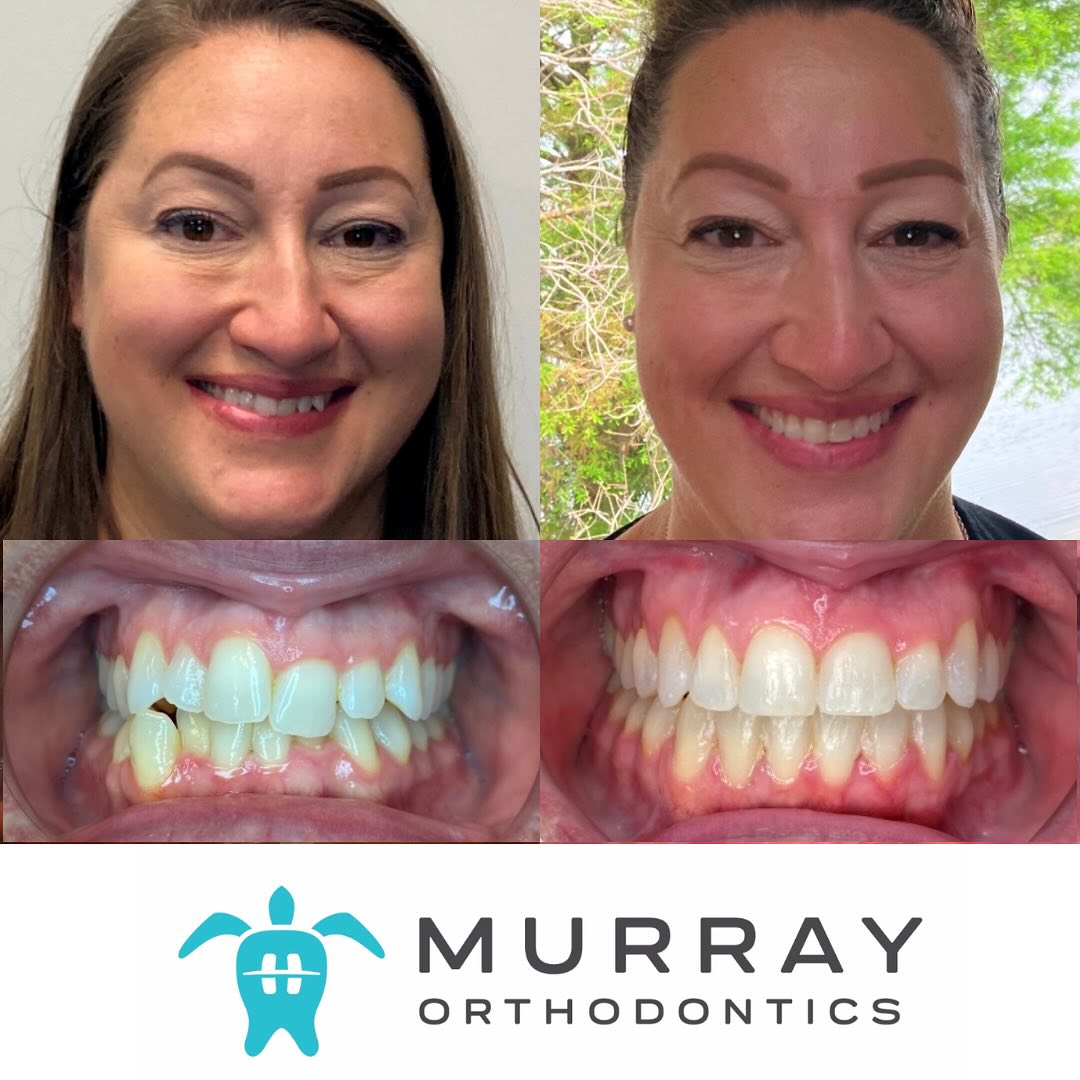
A severe open bite, closed without surgery. This adult patient’s front teeth didn’t touch at all, so she couldn’t chew with them. Dr. Murray closed it with clear aligners in 16 months. See the case.
A narrow smile, broadened. Her smile looked narrow, and her back teeth didn’t show when she smiled. Dr. Murray used clear aligners to widen her smile. See the case.
“My wife and I decided to get aligners and researched many options before selecting Dr. Murray. He spent a considerable amount of time with us answering the barrage of questions we had.”
Kaminow, Google review, Royal Palm Beach
Results depend on each patient’s teeth, bite and treatment plan. You can see more cases in our before and after gallery.
Choosing an orthodontist for adults in Royal Palm Beach
The same orthodontist at every visit. Dr. Murray examines you, plans your treatment and checks your progress himself. You won’t be handed off to a rotating set of doctors.
Board certification you can check. Dr. Murray is a Board-Certified Orthodontist through the American Board of Orthodontics. Certification is voluntary, built on written and clinical exams, and renewed every 10 years.
Training. He earned his bachelor’s degree at Duke University, graduated at the top of his class at Nova Southeastern University’s dental school, and finished a three-year orthodontic residency at the University of Florida. He also has advanced training in adult orthodontics and Invisalign. Meet Dr. Murray.
A local practice with a long history. Murray Orthodontics is independently owned and has served Palm Beach County since 1991. Dr. Murray joined the practice in 2020. Dr. Murray is a three-time winner of Best Orthodontist in Palm Beach County, in 2023, 2024 and 2026, and some team members have been with the practice for 15 to 28 years.
Visiting our Royal Palm Beach office
Murray Orthodontics is in Suite 201 at 685 Royal Palm Beach Blvd, with free parking on site. When you arrive, look for Suite 201 and the Murray Orthodontics name. Most Wellington neighborhoods are about 10 to 15 minutes away, and we also see adults from Westlake, The Acreage, Loxahatchee and Greenacres.
Murray Orthodontics, Royal Palm Beach
685 Royal Palm Beach Blvd, Suite 201, Royal Palm Beach, FL 33411
(561) 795-7707
Monday to Thursday, 8:30 AM to 5:00 PM. Closed Friday to Sunday.
If you work closer to Palm Beach Gardens, our Palm Beach Gardens adult orthodontics page covers that office. Same doctor, same pricing. More about this office is on our Royal Palm Beach office page.
or call (561) 795-7707
Frequently asked questions about adult orthodontics
Am I too old for braces or Invisalign?
No. As long as your teeth and gums are healthy, teeth can be moved at any age. We treat Invisalign patients well into their seventies.
Does adult treatment take longer than a teen’s?
Sometimes, a little. Adult teeth move the same way teen teeth do, and the timeline can run slightly longer depending on how the bite has developed over the years.
Do I need a referral from my dentist?
No. You can book a free consultation with Dr. Murray directly.
Do I keep seeing my regular dentist during treatment?
Yes. Keep up your dental checkups and cleanings the whole time you’re in braces or aligners.
Can I get braces or Invisalign if I have crowns, bridges or implants?
Often, yes. Tell Dr. Murray about any dental work at your consultation. Some adult cases with certain restorations or implants are better suited to braces than aligners, and he’ll tell you which applies to you.
Will I need teeth pulled?
Sometimes, but often not. In a lot of cases Dr. Murray can make room without removing anything. With severe crowding, taking out one or more teeth is sometimes part of the safest, most stable plan.
Can I straighten just my top or bottom teeth?
Once in a while, for very minor spacing. More often, moving only one arch throws off the bite, because your upper and lower teeth have to meet correctly. Dr. Murray checks how they come together before recommending anything.
Do braces hurt as an adult?
Expect soreness for a few days after your braces go on and after some adjustments. Our shape-memory NiTi wires apply steady, lighter pressure, and soft foods help. With aligners, most people feel pressure rather than pain for the first two or three days of a new set.
What happens if I lose an aligner?
Call the office. Depending on where you are in the series, you’ll usually go back to your previous set or move ahead to the next one while a replacement is ordered. Don’t skip ahead without checking with us.
I started treatment with another orthodontist. Can I switch?
Yes. Transferring doesn’t mean starting over. Bring your records, and Dr. Murray will review your current plan and continue from where you left off. Our transfer FAQ covers the details.
Can I whiten my teeth too?
Yes. We offer in-office Boost Whitening and at-home Go Trays. Ask Dr. Murray about the right timing at your consultation.
Find out what your treatment would involve
You’ll leave your free consultation knowing what’s going on with your teeth and bite, which options fit, how long it would take and what it would cost. No commitment.
or call (561) 795-7707