Written and clinically reviewed by Jonathan Murray, DMD, MS, ABO-Board Certified, orthodontist at Murray Orthodontics in Palm Beach Gardens and Royal Palm Beach. Last reviewed August 2026.
A gap between your front teeth isn’t one condition. It’s about six, and they all look identical in the mirror.
The space can come from the size of your teeth, from a tooth that never fully developed, from a band of tissue inside your upper lip, from a habit that ended years ago, or from bone loss that started long before the gap became visible. Same picture, completely different answers. One of those answers is to leave it alone.
That last one is worth saying plainly, because it isn’t what anyone selling orthodontic treatment tends to lead with. Plenty of gaps are stable, healthy, and purely cosmetic.
Which version you have isn’t something you can tell from a photo, and it isn’t something a website can diagnose. It takes an exam, and at Murray Orthodontics that exam is free whether you start treatment or not.
What this page can do is show you what Dr. Murray looks for, what he does about each cause, and what it costs, so you walk in already knowing which questions to ask.

- ABO Board-Certified Orthodontist
- Best Orthodontist in Palm Beach County, 2023, 2024 and 2026
- Free consultation, about an hour
- No-interest payment plans, set up in house
- Two Palm Beach County offices
- Caring for local families since 1991
The short answer: A gap between teeth, clinically called a diastema, doesn’t always require treatment. It’s worth having looked at when the space is widening, traps food, changes how your bite fits together, appeared suddenly in adulthood or alongside bleeding, receding, or swollen gums, or sits where a tooth is missing or undersized.
Braces and Invisalign can close many kinds of spacing predictably, provided the supporting gums and bone are healthy and the underlying cause is addressed.
At our Palm Beach Gardens office on Burns Road, Dr. Murray sees children, teens, and adults with isolated front-tooth gaps, spacing across the whole arch, missing lateral incisors, and spaces that have recently started to widen.
Does a gap between your teeth actually need treatment?
Start with the cosmetic case, since it’s the one most likely to apply to you. If your bite fits together properly, your gums are healthy, and the spacing hasn’t changed in years, a small gap between your front teeth is a feature rather than a finding. Some patients love theirs. Nobody at our office is going to talk you out of it.
Here’s when spacing stops being cosmetic and starts being clinical:
The gap is getting wider. Spacing that changes in adulthood usually means something is moving it. That’s worth investigating before it goes further.
Food packs into it constantly. Open contacts between teeth trap food against the gum, which raises your risk of decay and gum inflammation in exactly the spot that’s hardest to clean.
Your bite doesn’t fit together. Spacing in one arch and not the other changes how your teeth meet. Over years, that uneven contact can wear enamel unevenly.
Your gums are receding around it. Gaps caused by bone loss are a periodontal issue first and an orthodontic issue second. That sequence matters, and getting it backward causes damage.
A tooth is missing or undersized. The space left by a missing tooth doesn’t stay still. Neighboring teeth drift and tip into it, which makes replacing that tooth later harder and more expensive.
If none of those describe you, you have a choice to make rather than a problem to solve. That’s a good position to be in, and you should hear it plainly from someone qualified to say it.
Is your gap worth getting looked at?
Orthodontic treatment options for gap teeth
How Dr. Murray closes a gap depends far more on what caused it than on the size of the space. Orthodontics moves teeth, so it is the right tool when the teeth themselves are in the wrong position. If the space exists because a tooth is missing or undersized, part of the answer may sit outside orthodontics, and Dr. Murray will tell you that rather than treat around it.
Invisalign
Many adults with uncomplicated spacing ask about Invisalign first. Clear aligners are well suited to closing spaces, and because they’re removable, you take them out for meals, brushing, and flossing. Dr. Murray has advanced Invisalign training and plans these cases in 3D before your first tray is made, so the movement is mapped out rather than improvised.
Check-in visits land roughly every eight to twelve weeks, which suits patients who travel or work unpredictable hours.
Metal braces
Traditional metal braces give Dr. Murray the most direct control over each tooth, which matters when spacing comes with a bite correction or when several teeth need precise repositioning. The brackets are far smaller than what you remember from the nineties, and the shape-memory wires we use apply steady, light force instead of the hard tightening appointments people dread. Adjustments run every six to eight weeks.
Clear braces
Clear ceramic braces work the same way metal braces do, with brackets that blend against your enamel. They’re the usual pick for adults who need fixed appliances but spend their days in front of clients.
Not sure which fits your case? That’s exactly what the consultation is for. Dr. Murray examines your teeth himself and tells you what he’d recommend and why, including when two options would both work and the choice is yours.
How long does it take?
An isolated gap between two front teeth, with a healthy bite behind it, is often closed within a few months. What takes longer is finishing properly. Closing the visible space is only part of treatment, since root position and bite finishing also affect how stable the result will be.
Full treatment for most spacing cases runs somewhere in the range of twelve to twenty months. Cases involving a missing lateral, significant bite correction, or coordination with your dentist for a restoration take longer. Dr. Murray gives you a specific estimate for your case at your consultation, not a brochure number.
What gap treatment costs in Palm Beach Gardens
Cost is the reason most people put this off, and vagueness about it is the reason they put it off longer. As of August 2026, the real ranges are:
What closing a gap costs here
- Metal braces$3,000 to $7,000
- Clear braces$3,500 to $7,500
- Invisalign$3,500 to $7,500
- Your insurance benefits checked before you arrive
- A no-interest payment plan set up in house
- Retainers and the plan for keeping the gap closed
- A written breakdown before you commit to anything
Payment plans at Murray Orthodontics are always no interest, set up in-house, with no third-party lender in the middle. We check your insurance benefits before you arrive so the number you hear at your consultation is the real one. There’s also a discount for paying in full if that suits you better.
You’ll get your complete financial breakdown at your free consultation, before you commit to anything. Not a ballpark on the phone and a surprise later. If you want to get a head start, our guide to paying for orthodontic treatment in Palm Beach County covers insurance, FSA and HSA dollars, and what actually moves the number.
You can also see what braces cost in Palm Beach Gardens across all case types.
A real gap result from our Palm Beach Gardens office
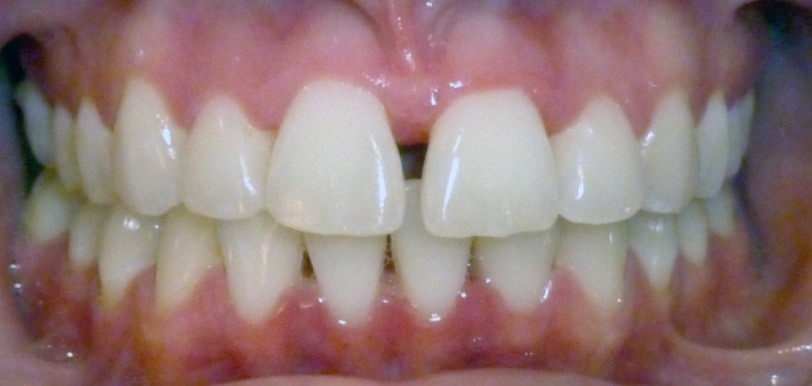
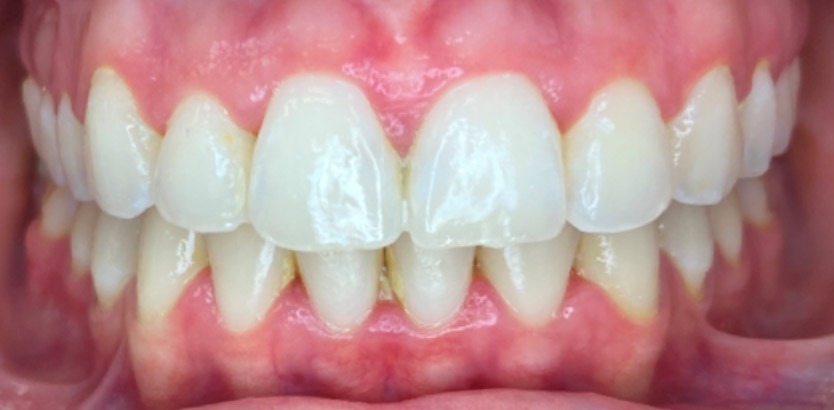
Rainey M. came to our Palm Beach Gardens office as a teen with a gap between her front teeth. Dr. Murray treated her with Invisalign, and her before and after photos show the space closed and the front teeth aligned.
Gap closed in 8 months with clear aligners
- 8 months
- Clear aligners
- Deep bite corrected
- Midlines matched
More finished cases are in our before and after gallery.
What causes gaps between teeth
Your teeth are small relative to your jaw
One of the most common causes is also the least dramatic. If your jaw is wide and your teeth are narrow, there’s more room than there are teeth to fill it, and the extra space distributes itself between them. This is genetic. You didn’t do anything to cause it, and no habit change will reverse it.
An undersized or missing lateral incisor
The teeth on either side of your two front teeth are called lateral incisors. Some people are born with laterals that are unusually small, and some are born without one or both.
Either way, the space that tooth should have filled ends up spread across the front of the smile. This one changes the treatment plan significantly, because we have to decide up front whether to close the space or open it properly for your dentist to restore later.
A thick or low labial frenum
That band of tissue connecting your upper lip to your gum is the labial frenum. In some patients, its size or attachment contributes to a midline gap that won’t close on its own. Dr. Murray checks for this at your exam because it can change the plan. When he judges the tissue clinically significant, he may coordinate a frenectomy with the appropriate specialist.
Timing depends on your age, which teeth have come in, and how the space responds to orthodontic closure, so it isn’t an automatic first step.
Tongue thrust and thumb sucking
Repeated pressure from a persistent oral habit can contribute to flaring and spacing. A tongue that pushes forward against the front teeth during swallowing, or a thumb habit that lasted past the age when permanent teeth arrived, can flare the upper front teeth outward and open space between them.
The habit has to be addressed alongside the tooth movement, or the pressure that created the gap will simply recreate it. We handle habits with conversation and encouragement first, and appliances rarely.
Gum disease and adult tooth shifting
This is the one people search for at 11pm, and it’s the one worth taking seriously. If a gap opens up in your thirties, forties, or fifties when it wasn’t there before, the cause is often loss of the bone and attachment holding your teeth in position. Advanced gum disease destroys the bone that supports the teeth, and teeth that lose support drift and flare.
Straightening teeth on a compromised foundation without treating the underlying gum condition first can accelerate the problem. If Dr. Murray sees signs of this at your exam, he’ll tell you what has to happen and in what order.
Gaps in your child’s teeth are usually good news
If you’re here because your six-year-old suddenly has spaces across the front of their smile, take a breath.
Spacing in baby teeth is normal and, frankly, welcome. Baby teeth are smaller than the permanent teeth waiting behind them. A child with tightly packed baby teeth has less room for what’s coming, not more. Those gaps are room to grow into.
There’s also a stage orthodontists have nicknamed the ugly duckling phase, usually somewhere around ages seven to nine, where the permanent front teeth erupt with a gap between them and a slight outward angle. The canines coming in later push against the roots and typically close that space on their own. Many parents panic at exactly the moment nothing is wrong.
That said, the American Association of Orthodontists recommends a first orthodontic check-up no later than age seven, and spacing is a good example of why. By seven, a child has enough permanent teeth for an orthodontist to tell the difference between normal spacing and a developing problem.
Our own guide covers what that age seven visit looks like. An exam tells you whether you’re watching a normal phase or a developing problem that’s easier to guide now than correct later.
Most kids we see at seven need nothing but a recheck. When early treatment does help, catching it early is the whole point.
Not sure if your child’s spacing is normal?
Please don’t try to close a gap at home
One of the most common questions about gap teeth is whether the space can be closed at home. The answer is no, not safely, and this is the part where real harm happens.
Do not put an elastic band around your front teeth. Not a hair tie, not a rubber band, not a product sold online as a “gap band.”
Here’s what happens. The band tightens, and because it has nothing to hold it in place, it slides up the tapered surface of the teeth and under the gumline. From there it keeps working its way toward the roots, cutting through the ligament and bone that anchor the teeth. It can disappear beneath the gum entirely, so you stop being able to see or feel it while it’s still doing damage.
This isn’t hypothetical. The American Journal of Orthodontics and Dentofacial Orthopedics published a case in December 2018, summarized by the American Association of Orthodontists, of an eight-year-old boy whose parents used a small rubber band to close the gap between his front teeth. The gap closed in two days and the band vanished.
They assumed it had broken. It hadn’t. By the time the pain sent him to a dentist, x-rays showed he had lost more than 75 percent of the bone holding those teeth in place. Both front teeth were lost.
A hair elastic costs about a nickel. Replacing two front teeth does not.
Two more things worth saying plainly. Filing or reshaping your own teeth removes enamel that doesn’t regenerate. And mail-order aligner kits ordered without an in-person exam and x-rays are a bad idea for spacing specifically, because they can’t tell whether your gap is from tooth size or from bone loss. Moving teeth on a compromised foundation makes the underlying problem worse while the aligners appear to be working.
If you want the gap gone, that’s completely reasonable. Get it done in a way that leaves you with teeth.
Before you try anything at home, let someone look at it
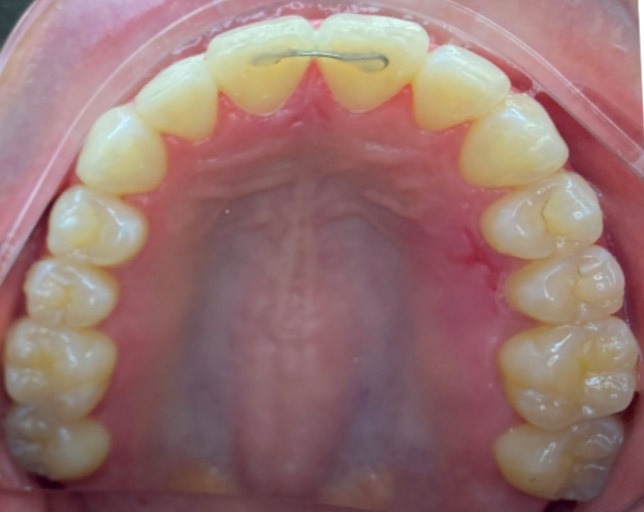
The part most offices skip: keeping it closed
Closed gaps want to reopen. Of everything we correct, spacing has the strongest tendency to relapse, and it’s the reason people show up in our office having already had braces once as a teenager.
The tissue between teeth has elastic fibers that remember where they used to be. Those fibers keep pulling long after treatment ends. This isn’t a failure of the orthodontics. It’s biology, and it’s manageable, but only if someone plans for it.
Retention starts the day your braces come off, and at Murray Orthodontics that means wearing your retainer at night from day one. No all-day phase, no complicated schedule to fall off of. For gap cases specifically, Dr. Murray will often discuss a bonded retainer wire placed behind the front teeth, which reduces how much you have to rely on remembering a removable retainer. The wire still needs careful cleaning and periodic checks, since bonded retainers can loosen or break.
If someone quotes you a price for closing a gap and doesn’t bring up retention in the same conversation, you’re being quoted for half the job.
What holding a closed gap actually looks like
What happens at your free consultation
It runs about an hour, and it costs nothing whether you start treatment or not.
Our front desk greets you by name, because they’ll have your paperwork ready before you walk in. We take x-rays and photos, which is the imaging Dr. Murray needs to see what’s happening below the surface, including the bone level around teeth with spacing.
Then Dr. Murray examines your teeth and bite himself. Not an assistant, not a treatment coordinator with a script. He looks at what’s causing your gap specifically, explains what he finds in language that makes sense, and walks you through what he’d recommend and how long it would take.
Every recommendation on this page depends on that exam. What’s causing your spacing, whether your gums and bone are healthy enough to move teeth safely, and how your bite fits together are things nobody can determine from a photo or a phone call. That’s the whole reason the consultation is free.
You’ll leave with a treatment plan, a timeline, and a complete cost breakdown including your insurance benefits. If you’re ready and the plan works for you, we can often start the same day.
You can read more about what to expect at your first visit before you come in.
What changes after
The thing patients tell us afterward usually isn’t about their teeth.
It’s that they stopped doing the thing they hadn’t realized they were doing. The hand that came up during meetings. The closed-mouth version of the smile that got used for every photo for fifteen years.
One of our patients came in at fifty for a consultation. In her review she wrote that Dr. Murray listened to the results she wanted and offered his knowledge and expertise, and that the staff were polite and friendly at every visit. Another finished treatment and said the results exceeded her expectations.
Neither of them thought they were still a candidate when they first called.
Nearly half the patients Dr. Murray treats are adults. If part of what’s kept you from calling is a sense that you missed your window, you didn’t, and you’d be in more company than you’d expect.
Take a look at our before and after results and see for yourself, or read what our patients say about being here.
You get to decide whether to close your gap. What you shouldn’t have to do is decide without real information, or spend another decade wondering whether it’s getting worse.
What Palm Beach Gardens families say
Frequently Asked Questions
Can braces close a gap in my front teeth?
Yes. Braces close spacing predictably, and it’s one of the more reliable corrections in orthodontics. Both fixed braces and clear aligners work well for gaps. Which one Dr. Murray recommends depends on what’s causing your gap and whether your bite needs correcting at the same time.
How can I close a gap in my teeth without braces?
Clear aligners such as Invisalign move teeth without fixed brackets, so most spacing can be closed without traditional braces. If your gap comes from narrow teeth or a missing tooth rather than tooth position, the answer may lie outside orthodontics, and Dr. Murray will tell you that at your exam and coordinate with your dentist.
What won’t work is anything you do at home.
Why am I suddenly getting a gap in my front teeth as an adult?
New spacing in adulthood usually means teeth are shifting for a reason, most often loss of gum and bone support, an unaddressed tongue habit, or drift into a space where a tooth was lost. It’s worth an exam. The cause determines the treatment, and some causes get worse with time.
Are gap teeth genetic?
Often, yes. Tooth size, jaw width, and frenum attachment are all inherited, and those three factors cause most naturally occurring gaps. If a parent has spacing, a child is more likely to. Genetic spacing is usually treatable, though undersized or missing teeth may need your dentist involved in the plan as well.
Do gaps in my child’s teeth close on their own?
Frequently. Spacing in baby teeth is normal and helpful, since permanent teeth need that room. A gap between newly erupted permanent front teeth often closes as the canines come in. An evaluation around age seven tells you whether you’re watching a normal phase or something that needs guidance.
How long does it take to close a gap with braces?
A small, isolated gap can visibly close within a few months. Full treatment usually runs about twelve to twenty months, because roots need to be positioned properly and the bite has to settle for the result to hold. Dr. Murray gives you a case-specific estimate at your consultation.
Why did a gap appear between my front teeth during my braces treatment?
This is normal and expected in many cases. Teeth move in sequence, and space sometimes opens temporarily while crowding is relieved or the bite is corrected before everything is brought together at the end. If it worries you, ask at your next visit and we’ll show you where it fits in your plan.
Will my gap come back after treatment?
Gaps have a strong tendency to reopen, because the fibers between teeth keep pulling toward their old position. Wearing your retainer at night as prescribed, starting the day your braces come off, greatly reduces that risk. Retainers still need monitoring, and they should be replaced if they loosen, break, or stop fitting.
Will a frenectomy close a gap on its own?
No. Releasing or reducing the labial frenum addresses tissue that may be contributing to the space, but it does not move teeth together by itself. Orthodontic treatment is usually still needed to close the gap, and the timing of the two is a clinical judgment Dr. Murray makes case by case.
Do I have to fix my gap if it doesn’t bother me?
No. If your bite functions well, your gums are healthy, and the spacing is stable, a gap is a cosmetic feature and the decision is entirely yours. Dr. Murray will tell you honestly whether yours is stable or changing so you can decide with real information.
About the orthodontist who reviewed this page
Jonathan Murray, DMD, MS, ABO-Board Certified
Dr. Murray earned his Bachelor of Science at Duke University and his DMD at Nova Southeastern University, where he graduated at the top of his class and was inducted into the Omicron Kappa Upsilon dental honor society. He completed a three-year orthodontic residency at the University of Florida, earning both his Certificate in Orthodontics and Dentofacial Orthopedics and a Master of Science.
He is certified by the American Board of Orthodontics. Certification is voluntary, requires peer-developed written and clinical examinations, and has to be renewed every ten years. You can confirm any orthodontist’s certification through the ABO’s public orthodontist locator.
He is a member of the American Association of Orthodontists and the American Dental Association, and has advanced training in Invisalign and in treating patients with special needs or high dental anxiety.
Read Dr. Murray’s full background