Reviewed by Dr. Jonathan Murray, Board-Certified Orthodontist. Last updated June 2026.
Your child’s dentist mentioned Phase 1 treatment, and now you have questions. Maybe a friend’s kid got an expander at seven and you’re wondering if your own child needs one too. Or maybe you typed “is Phase 1 orthodontics a scam” into Google last night after the appointment, because braces on a child who still believes in the Tooth Fairy just feels like a lot.
That instinct to pause and ask questions is a good one. Plenty of children who come in for an early evaluation do not need treatment yet, and a trustworthy orthodontist will tell you that plainly.
At Murray Orthodontics, that is exactly what you’ll get from Dr. Murray: a straight answer about whether early treatment is the right call for your child, or whether the smarter move is simply to watch and wait.
What Phase 1 Orthodontics Actually Is
Phase 1 is early, focused orthodontic treatment for children who still have a mix of baby teeth and adult teeth, usually somewhere around ages seven to ten. It is sometimes called early treatment or interceptive treatment, and the goal is not a perfect, photo-ready smile right away.
The goal is narrower than that. Phase 1 addresses one or two specific developing problems while your child is still growing, so those problems do not turn into bigger, more expensive ones later. Think of it as guiding the jaw and making room while the bones are still soft and cooperative, rather than waiting and forcing things into place once everything has hardened.
Most kids do not need it. For the ones who do, the right timing can shorten or simplify whatever treatment comes later, and in some cases head off the need for tooth extractions or jaw surgery down the road.
Why Age 7 Comes Up So Often
The American Association of Orthodontists recommends that every child have a first orthodontic evaluation by age seven. This is the part that trips parents up, because it sounds like the AAO is recommending braces at seven. It is not.
By age seven, enough adult teeth have come in and enough jaw growth has happened that an experienced orthodontist can spot developing problems early: a narrow upper jaw, a crossbite, severe crowding, a bite that is drifting in the wrong direction. Spotting those things early does not mean treating them early. It means Dr. Murray can tell you whether to act now, keep an eye on it, or stop worrying about it entirely.
That last outcome is more common than you might think. A large share of these early evaluations end with Dr. Murray saying some version of “everything is developing the way it should, let’s just check in periodically.” There is no charge to hear that, and there is no pressure to do anything else.
Signs your child may benefit from an early evaluation
Most parents notice everyday things, not orthodontic problems. None of these mean your child needs treatment. Any of them is worth an evaluation while the jaw is still developing:
- Upper and lower teeth that do not seem to meet or line up correctly
- Difficulty or discomfort chewing, or biting that looks uneven
- Front teeth that protrude, or upper teeth that sit behind the lower ones
- Thumb-sucking that has continued past age four or five
- Persistent mouth breathing
- Severe crowding, or adult teeth coming in twisted or in unusual spots
- Baby teeth lost much earlier or much later than expected
See a few of these? It is probably nothing, but an evaluation is the only way to know. Often it turns out to be a normal part of a child still in mixed dentition, with baby and adult teeth side by side. Either way, you leave knowing.
“Is Phase 1 a Scam?” Let’s Talk About That Directly
You are protective of your child and protective of your wallet, and the internet is full of stories about families who felt pushed into expensive treatment by high-volume clinics that treat patients like line items. Those stories are real, and the skepticism they create is fair.
Here is how Murray Orthodontics is different. Dr. Murray is a Board-Certified Orthodontist, which is the highest credential in the specialty and one that not every orthodontist pursues. He examines your child personally at the consultation. Not an assistant, not a treatment coordinator with a sales script. He looks at the teeth and bite himself, explains what he sees in plain language, and gives you an honest recommendation.
If your child needs Phase 1, he’ll explain exactly why, what it will accomplish, and what it costs before you commit to anything. If your child does not need it, he’ll say so. And if you want a second opinion after an evaluation somewhere else, that is a completely reasonable thing to want, and we welcome it. A practice that is confident in its recommendations has no reason to fear a second set of eyes.
What Phase 1 Treatment Looks Like at Murray Orthodontics
Phase 1 is targeted, not comprehensive. When Dr. Murray does recommend it, the most common appliance is a palate expander, often paired with a short course of braces to address a specific issue. The expander is a custom appliance that gently widens a narrow upper jaw over a matter of weeks, creating room for adult teeth and correcting crossbites before they become harder to fix.
You can read the full breakdown on our palate expander page, including how the daily key turns work and what the active expansion period feels like for your child. The short version: kids adapt to it remarkably fast, and the brief pressure after each turn passes quickly.
The specific conditions Phase 1 is most useful for include:
- A narrow upper jaw or crossbite, where the upper and lower teeth do not line up correctly
- Significant crowding, where there is clearly not enough room for the adult teeth coming in
- An open bite often tied to thumb-sucking or tongue-thrusting habits
- A protruding bite or overjet with a skeletal component, where guiding jaw growth early makes a real difference
- Early loss of baby teeth, where holding space open prevents the remaining teeth from drifting
Every child is different, which is why none of this gets decided from a webpage. It gets decided after Dr. Murray actually looks at your child’s mouth.
Which Kids Usually Do Not Need Phase 1
Just as important as knowing who benefits is knowing who can wait, because most children fall into this group. Early treatment usually is not the right call when a child has mild crowding that can be handled later, a minor bite issue with no skeletal component, or simply teeth that look a little crooked while everything is still developing normally. Crooked baby teeth on their own are rarely a reason to start treatment.
In these cases, the smarter, less expensive path is to do nothing yet and watch. Dr. Murray’s Growth and Development Program exists for exactly this: regular, no-cost check-ins so that if a problem does start to develop, you catch it at the right moment, and if it never does, you have spent nothing chasing a treatment your child did not need. Doing less, when less is the right answer, is part of honest orthodontic care.
Treating now vs. waiting
The real decision is not “braces or no braces.” It is “treat now, or wait and watch.” Here is the honest version of how that call gets made.
- There is a crossbite or narrow upper jaw affecting how the bite works
- A skeletal or jaw issue can be guided while your child is still growing
- Severe crowding leaves no room for the adult teeth coming in
- A habit like thumb-sucking is actively shaping the bite
- Front teeth protrude far enough to be at real risk of injury
- Crowding is mild and can be handled later with full braces
- The concern is cosmetic, with no functional or skeletal component
- Baby teeth look crooked but the adult teeth have not come in yet
- There is no sign the problem will get harder to fix over time
- Growth is on track and nothing needs intervention right now
Only an exam tells you which column your child is in. Dr. Murray will put your child in the honest column, not the profitable one.
What Happens After Phase 1: The Resting Period
This is the part competitors tend to gloss over, so let’s be upfront. Phase 1 does not usually replace later treatment. After the early appliance does its job, your child enters a resting period while the rest of the permanent teeth come in. Many children will still need a Phase 2 round of braces or Invisalign in their teen years to finish the alignment.
So why do Phase 1 at all? Because the early work handles the hard, growth-dependent problems while the window is open, which often makes that later phase shorter and simpler than it would have been otherwise. A skeletal issue that is straightforward to guide at age eight can become a much bigger project, sometimes a surgical one, if it waits until growth is finished.
During the resting period, Dr. Murray keeps an eye on your child’s bite at regular intervals, so Phase 2 starts at exactly the right moment. Not too early, not too late. You are not paying for a holding pattern, and you are not left guessing about timing.
Our No-Cost Growth and Development Program
This is one of the things that sets the practice apart, so it deserves its own heading. Whether your child is being watched before any treatment or resting between phases, Dr. Murray’s Growth and Development Program provides periodic monitoring of jaw development and erupting teeth at no charge.
Here is why that matters. With orthodontics, timing is often everything. Act too early and you treat a problem that might have resolved on its own. Act too late and you miss the growth window that made early intervention worthwhile in the first place. Regular monitoring means treatment, if it is ever needed, begins at the right moment and not a visit sooner. Many children stay in this program for years and never need a single appliance, and that is a perfectly good outcome.
What Phase 1 costs in Palm Beach Gardens
Less than full braces, because Phase 1 is focused and time-limited
Free consultation, about an hour, no obligation
For a wider look at orthodontic pricing across treatments, our cost guide walks through the ranges.
What to expect at your child’s Phase 1 consultation
The first visit is free, takes about an hour, and is built to answer your questions, not to pressure you.
Greeted by name
Your family is welcomed at the front desk. Kids tend to relax quickly once they see the office is more welcoming than clinical.
X-rays and photos
We take the X-rays and photos needed to evaluate your child’s teeth, bite, and jaw development.
Dr. Murray examines your child personally
The orthodontist himself, not an assistant or a coordinator, looks at the teeth and bite and how everything is developing.
A clear recommendation
He explains what he sees in plain language: early treatment now, a spot in the monitoring program, or simply no action needed yet.
A complete financial breakdown
If treatment makes sense, you get the full cost before you commit to anything, and you can start the same day if you are ready.
You can see what your first visit involves in more detail, but the short version is that you will leave understanding exactly where your child stands.
A Real Phase 1 Story: Felipe’s Crossbite
Felipe’s parents did not come in asking about braces. They came in worried about his gums. One of his lower front teeth had started to show recession, the gum line creeping down in a way that did not look right, and they wanted to know why.
The answer turned out to matter more than they expected. When Dr. Murray examined Felipe, he found an anterior crossbite: the upper and lower front teeth were meeting in the wrong position, and that bad contact was pushing on the lower tooth and wearing the gum away. Left alone, this was not going to stay a small problem. Over time it could have meant permanent damage to those teeth, including wear, fracture, worsening recession, a tooth working loose, even tooth loss.
Here is the part Felipe’s parents got right without knowing it. They brought him in at age nine, and that timing was everything. Dr. Murray treated him with about twelve to fifteen months of Phase 1 braces to correct the crossbite and bring the front teeth into proper alignment. Once the crossbite was gone and the teeth met the way they should, the pressure on that lower tooth stopped, and the gums began to heal and recover.
Had Felipe come in at eleven or twelve instead, or later, the damage to that tooth might have been irreversible. The same problem, caught a few years on, can cross the line from fixable to permanent. Catching it at nine was the difference between a focused course of early treatment and a lifelong issue. That is exactly what the age-seven evaluation is for, and exactly the kind of thing Dr. Murray watches for.
Felipe’s crossbite, caught in time at age 9
His smile, before and after
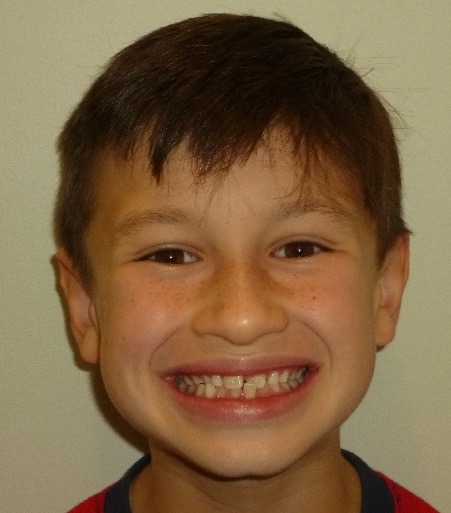
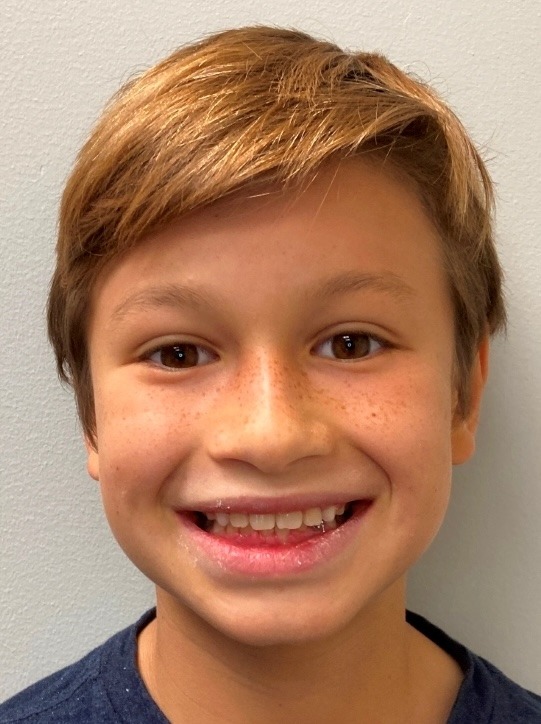
The crossbite, before and after
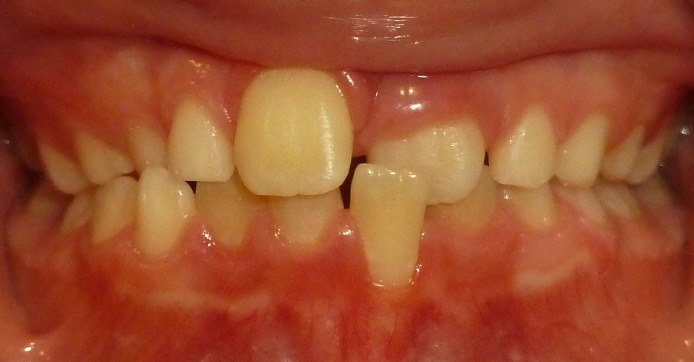
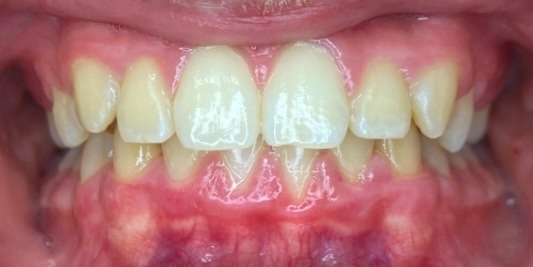
Felipe’s parents did not come in asking about braces. They came in worried about his gums, where one lower front tooth had started to show recession. Dr. Murray found the cause: an anterior crossbite pushing on that tooth and wearing the gum away. Left alone, it could have meant permanent damage. Caught at nine, it was fixable. Once the crossbite was corrected, the pressure stopped and the gums began to heal.
Why Palm Beach County Families Choose Murray Orthodontics
Choosing who guides your child’s care is a bigger decision than choosing where to get teeth straightened. You want someone you trust, and you want an experience that does not feel like a factory.
Dr. Murray has been voted Best Orthodontist in Palm Beach County by the Community Choice Awards three times, and the practice is consistently recognized as one of the area’s top orthodontists. He trained at Duke University, earned his DMD at Nova Southeastern University, and completed a three-year orthodontic residency at the University of Florida. Murray Orthodontics has been a part of Palm Beach County since 1991, and Dr. Murray has led the practice since 2021.
What families tell us they remember, though, is not the credentials. It is the feel of the place. This is a boutique practice, which means the front desk knows your child’s name, you see the same orthodontist at every single visit, and the office is bright and modern with video games and refreshments rather than the stuffy, clinical feel kids dread. Some of our team members have been here fifteen to twenty-eight years, so the faces stay familiar from one appointment to the next. The Palm Beach Gardens office sits in The Oaks Center with easy access from I-95, which is part of why families from Jupiter and the surrounding north-county communities make the short drive for their children’s care.
That is the kind of experience parents end up telling their friends about, and a good chunk of our new families come from exactly that: a neighbor or a coworker who said “you have to take your kid to Dr. Murray.” You can read what local families say on our testimonials page.
What Palm Beach County parents say
Real reviews from local families, pulled live from our Palm Beach Gardens Google profile.
Phase 1 Orthodontics: Common Questions
Does my child really need Phase 1, or can we wait?
Many children do not need early treatment, and waiting is often the right call. The only way to know is an evaluation. Dr. Murray will examine your child’s teeth and bite, tell you honestly whether early treatment would help, and explain why. If waiting is smarter, he’ll say so.
Is my 7-year-old too young for braces?
An evaluation at seven does not mean braces at seven. The age-7 recommendation from the American Association of Orthodontists exists so an orthodontist can spot developing problems early, not so every child starts treatment that young. Most seven-year-olds who come in are simply monitored.
How long does Phase 1 treatment take?
Phase 1 is a short, focused course of treatment, not a multi-year process. Most early treatment is wrapped up well before a child would otherwise start full braces. The exact length depends on what your child needs, and Dr. Murray will give you a clear timeline at your consultation before anything begins.
Will my child still need braces after Phase 1?
Often, yes. Phase 1 handles specific growth-related problems early, and a Phase 2 round of braces or aligners usually follows once all the permanent teeth are in. The benefit is that the early work tends to make that second phase shorter and simpler.
Does Phase 1 treatment hurt?
Children typically feel mild pressure or soreness for a few days after an appliance is placed or adjusted, easily managed with over-the-counter children’s pain relief. With a palate expander, the pressure right after each key turn lasts only briefly. Kids adapt to all of it faster than parents expect.
How much does Phase 1 cost?
Phase 1 treatment at Murray Orthodontics typically ranges from $3,000 to $4,000, less than comprehensive braces because it is focused and time-limited. Insurance often covers part of it for children, and your free consultation includes a complete financial breakdown with no surprises.
Most children who finish Phase 1 go on to a full round of braces once the rest of the permanent teeth are in. That second stage is covered in our guide to braces for kids in Palm Beach Gardens.
Should I get a second opinion on Phase 1?
Absolutely, if you want one. If any recommendation feels rushed, oversized, or unclear, a second opinion is a reasonable and smart step. Dr. Murray welcomes families coming in for a second look, and the consultation is free.
Can early treatment prevent jaw surgery later?
Sometimes, yes. When a bite problem has a skeletal component, guiding jaw growth while a child is still developing can reduce the likelihood that a more involved correction, including surgery, is needed in adulthood. It is not a guarantee, and it only applies to certain cases, which is exactly the kind of thing Dr. Murray evaluates at the consultation.
Visit Murray Orthodontics
Phase 1 evaluations for children happen at our Palm Beach Gardens office, conveniently located in The Oaks Center. Families come to us for early evaluations from across the north end of the county, including Palm Beach Gardens, Jupiter, North Palm Beach, Juno Beach, Palm Beach Shores, and Lake Park.
The first step is simple and free: a thorough exam with Dr. Murray, a clear explanation of what he finds, and an honest recommendation about whether early treatment makes sense for your child. No pressure, no sales pitch, no obligation.
Find out if your child needs Phase 1, for free
A thorough exam with Dr. Murray, a clear explanation of what he finds, and an honest recommendation. No pressure, no sales pitch, no obligation.
Book your free consultationMurray Orthodontics, Palm Beach Gardens
2517 Burns Rd, Palm Beach Gardens, FL 33410
Monday to Thursday, 8:30 AM to 5:00 PM