Reviewed by Dr. Jonathan Murray, DMD, MS — Board-Certified Orthodontist
If your child’s dentist mentioned overjet, or you’ve noticed front teeth sticking out and started googling, you’re probably trying to answer three things: what is this, does it need treatment, and how is it fixed?
Dr. Jonathan Murray is a Board-Certified Orthodontist in Palm Beach Gardens who treats overjet in kids, teens, and adults using braces, Invisalign, and growth-based treatment when appropriate. Overjet is one of the most common bite issues he sees and it’s very treatable.
Every new patient gets a free consultation.
Overjet means the upper front teeth stick out too far in front of the lower teeth. In children, teens, and adults, it can often be corrected with braces, Invisalign, or early orthodontic treatment depending on the cause and severity.
At Murray Orthodontics, Dr. Murray evaluates whether the overjet is caused by tooth position, jaw growth, or both, then recommends the most effective treatment at your free consultation.
What Is Overjet?
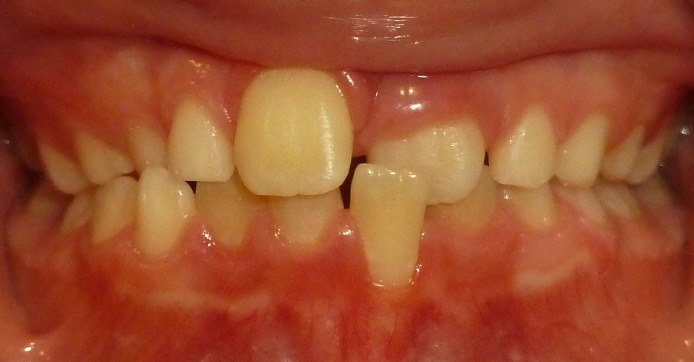
Overjet is when the upper front teeth protrude forward — horizontally — past the lower front teeth. Most people know it as “buck teeth.” The upper front teeth should sit about 2 millimeters ahead of the lower teeth when your mouth is closed. When that gap is larger than it should be, that’s an overjet.
Do I (or does my child) actually have this?
Do I (or does my child) have overjet?
You don’t need a measurement. Look for these signs:
- Upper front teeth look noticeably farther forward than the lower teeth
- Lips don’t rest together comfortably without effort
- Front teeth are visible even when the mouth is relaxed
- Biting into foods like apples or sandwiches feels awkward
- The lower lip naturally rests behind the upper front teeth
If two or more of those sound familiar, there’s likely something worth evaluating. Dr. Murray measures it precisely at your free consultation and tells you whether it warrants treatment, what kind, and when.
Schedule Your Free ConsultationOverjet vs. Overbite: What’s the Difference?
This is the most common point of confusion, and it matters because the two conditions are treated differently. Many parents in Palm Beach Gardens come in having been told their child has an “overbite” when what’s actually present is an overjet — or both.
The simplest way to keep them straight: overjet is about how far forward the teeth stick out. Overbite is about how much the upper teeth overlap the lower teeth when biting down.
Clinical term
Overjet
Also called: buck teeth
Clinical term
Overbite
Also called: deep bite
Many patients have both at the same time — they’re not mutually exclusive. A Board-Certified Orthodontist measures each separately because the distinction changes the treatment plan.
Why Overjet Happens
Overjet is usually a combination of factors, and in most cases it isn’t caused by anything anyone did wrong.
Genetics is the most common driver. Jaw size, proportion, and tooth positioning are largely inherited. If one or both parents have a more prominent upper jaw or a smaller lower jaw, there’s a real likelihood their children will too.
Childhood habits can push the teeth forward during the years when everything is still developing. Prolonged thumb sucking past age 4 or 5, extended pacifier use, and tongue thrusting all apply ongoing forward pressure that can shift the teeth and alter how the jaw develops.
Mouth breathing disrupts the natural pressure balance around the teeth over time, and teeth can drift forward as a result. Chronic mouth breathing can also have broader orthodontic implications — see airway orthodontics in Palm Beach Gardens for more on how this is evaluated and addressed.
Early tooth loss — losing baby teeth prematurely — can cause neighboring teeth to drift, sometimes creating or worsening an overjet.
Whether an overjet is primarily dental (tooth position) or skeletal (jaw structure) fundamentally changes what treatment looks like — more on that in the next section.
Dental Overjet vs. Skeletal Overjet: Why It Matters
This distinction matters because it affects which treatment options are likely to work best.
Teeth are positioned too far forward
The jaw bones are reasonably well proportioned, but the upper teeth themselves are tipped or angled forward. More common, and often simpler to treat.
Typical treatment
Braces or clear aligners move the upper teeth back into proper position.
The jaw itself is forward — or underdeveloped
The upper jaw sits further forward than the lower jaw, or the lower jaw hasn’t developed fully. The teeth are just sitting where they land on the bone.
Typical treatment
In growing patients: growth-based appliances. In adults with significant cases: surgical orthodontics.
Most people have some combination of both. The ratio between the two is one of the key things Dr. Murray determines at your free consultation — it shapes the entire treatment plan.
Do You Need Treatment for Overjet?
Some families notice protruding teeth but wonder whether it’s really worth treating, especially when there’s no pain. For most patients, the answer is yes — for several reasons that go beyond appearance.
Injury risk. Children with more pronounced overjet are at greater risk of injuring the front teeth during falls, sports, or everyday accidents. For active kids in Palm Beach Gardens playing soccer, baseball, or any sport year-round, this is a practical concern.
Chewing and bite function. When the front teeth don’t meet properly, biting into firm foods is genuinely harder. Most people adapt so gradually that they don’t realize how much they’ve been working around it until treatment is complete.
Speech. Protruding teeth commonly interfere with F, V, S, and SH sounds. The underlying bite issue usually needs to be addressed for lasting improvement.
Self-consciousness. Kids with visibly protruding teeth are frequently teased, and teenagers and adults carry real self-consciousness about their smile into social and professional situations. That’s worth taking seriously.
Long-term dental health. A misaligned bite distributes chewing forces unevenly. Over years, that can accelerate wear on specific teeth and increase stress on the jaw joints.
When Should a Child Be Evaluated for Overjet?
A child with protruding front teeth should be evaluated as soon as the issue is noticeable, especially if the teeth are at higher risk for injury or the lower jaw appears to be lagging behind.
The American Association of Orthodontists recommends a first orthodontic evaluation by age 7, not because 7-year-olds need treatment, but because that’s when enough permanent teeth have come in to assess how the bite is developing. There are 7 good reasons an early evaluation matters beyond just overjet.
Many children don’t need immediate treatment, but early evaluation determines whether growth-based correction could improve the outcome before that window closes. Murray Orthodontics offers orthodontic treatment for all ages — Dr. Murray will tell you clearly whether your child needs treatment now or simply careful monitoring, and that consultation is completely free.
Does Overjet Get Worse Over Time?
For children, waiting often has a real cost. The window for growth-based treatment is finite. While the jaw is still developing — roughly through the early to mid-teen years — orthodontic appliances can work with that growth to correct a skeletal overjet in ways that aren’t possible once growth is complete. A significant skeletal discrepancy that could have been largely corrected at age 10 may require surgical orthodontics in adulthood to fully address.
Early intervention done at the right time also often reduces the complexity and cost of Phase 2 treatment — braces or aligners — later. A more involved adult case typically means a longer timeline and higher overall cost.
For overjet that’s purely dental in nature, the timing pressure is less acute. Braces or aligners work at any age. But it’s still not worth delaying if the teeth are at elevated risk of injury or if self-consciousness is already affecting a child’s daily life.
The free consultation will tell you clearly whether timing matters for your specific situation.
Overjet Treatment Options in Palm Beach Gardens
Treatment is shaped by three things: the patient’s age, the severity of the overjet, and whether the cause is primarily dental or skeletal. There’s no one-size-fits-all approach here, which is part of why seeing a Board-Certified Orthodontist makes a real difference.
Braces
All agesThe most reliable option for most overjet cases, especially when meaningful bite correction is needed. Metal or clear ceramic brackets with shape-memory NiTi wires. Elastics help align the jaw relationship.
Metal braces in Palm Beach Gardens →Invisalign & Spark Aligners
Teens & adultsClear removable aligners that correct mild to moderate overjet effectively, particularly when the cause is dental. Dr. Murray is a top recommended Invisalign provider and evaluates whether your case is a good fit.
Invisalign in Palm Beach Gardens →Phase 1 Early Intervention
Children onlyFor younger patients with a skeletal component, functional appliances encourage the lower jaw to grow forward during the natural growth window. Only possible while the jaw is still developing.
Orthodontic treatment for all ages →Surgical Orthodontics
Severe skeletal casesFor adults with a significant skeletal overjet where jaw growth is finished. Orthodontic treatment coordinated with an oral surgeon. Dr. Murray identifies this at the consultation and manages the referral.
About surgical orthodontics →What Overjet Treatment Actually Feels Like Day to Day
Most orthodontic pages describe treatment options but say little about what you’re actually signing up for. Here’s the honest version.
For braces patients, the first few days after brackets are placed involve some tenderness and adjustment. After that initial period, most patients settle into a comfortable rhythm. Most patients describe the adjustment period as manageable and temporary, and the wires Dr. Murray uses apply gentle, continuous force throughout treatment.
Overjet correction with elastics requires consistent wear to work. Patients who wear them as directed move through this phase efficiently. Dr. Murray is upfront about what consistent wear looks like and what it means for the timeline when it doesn’t happen.
Check-in appointments for braces happen every 6 to 8 weeks. For Invisalign or Spark aligner patients, check-ins are typically every 8 to 12 weeks. At Murray Orthodontics, you see Dr. Murray at every visit — not a different associate or rotating staff member. For a case like overjet correction that involves active bite movement, having the same eyes and hands on your treatment throughout makes a real difference.
Early in treatment, changes happen beneath the surface before they’re visually obvious. Most braces patients start seeing visible improvement in the overjet somewhere around the midpoint of treatment.
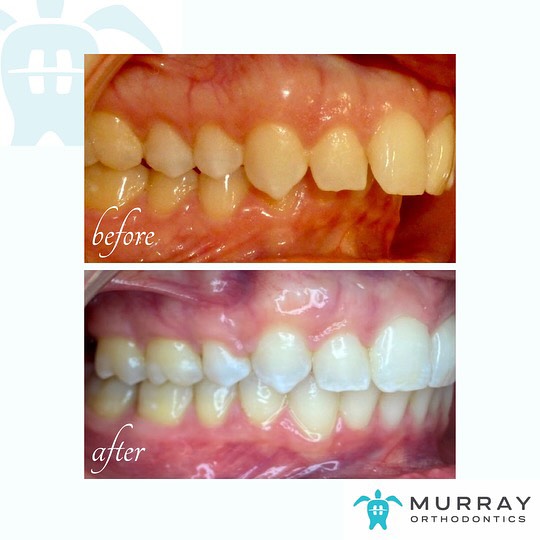
By the time braces come off, the change in how the bite fits together is usually significant — patients often notice for the first time how much easier it is to bite into food, close their lips naturally, and smile without thinking about it.
A Real Example of What This Looks Like
A family came into our Palm Beach Gardens office after their daughter’s dentist — at her 8-year-old checkup — flagged that her upper front teeth were noticeably protruding and suggested an orthodontic evaluation. Her parents weren’t sure if it was urgent or something to keep watching.
At the free consultation, Dr. Murray found a moderate overjet with a skeletal component — her lower jaw was lagging behind in development. Because she was 8 and still well within the growth window, there was a real opportunity to address the jaw relationship before it closed.
He recommended Phase 1 treatment to encourage lower jaw development during that growth period, followed by a monitoring phase, then braces once her remaining permanent teeth came in.
Her parents left knowing exactly what was happening, why the timing mattered, and what the full cost picture looked like — including how insurance factored in. That’s the consultation experience. Whatever your situation, you leave with a clear picture.
Cost of Overjet Treatment in Palm Beach Gardens
The cost depends on the severity of the bite problem, whether treatment happens in one phase or two, and whether braces or clear aligners are the best fit for your case.
Palm Beach Gardens
Cost of Overjet Treatment at Murray Orthodontics
Metal Braces
$3,000 – $7,000
Best for complex bite correction cases
Clear Braces & Invisalign
$3,500 – $7,500
Priced the same as each other
- Most Florida insurance plans accepted — benefits checked before your visit
- No-interest in-office payment plans with flexible down payment options
- Complete financial breakdown at your free consultation — no surprises
A Note for Adults Who’ve Had This Their Whole Life
If you’re an adult reading this rather than a parent researching for a child, this is for you.
A lot of adults with overjet spent their teen years being told it wasn’t severe enough to treat, or the timing never worked out. Now they’re in their 20s, 30s, or beyond, wondering if it’s too late or worth dealing with.
Overjet is very treatable in adults. Tooth movement works the same way, outcomes are excellent, and with Invisalign or clear braces the treatment is far less visible than most adults expect. About half of Dr. Murray’s patients are adults — learn more about adult orthodontic treatment in Palm Beach Gardens or read about why more adults are choosing orthodontic treatment than ever before. This is not a kids-first office with adults as an afterthought.
The one honest caveat: if your overjet is significant and skeletal in nature, the jaw relationship can’t be changed through orthodontics alone in adulthood — surgical orthodontics would be needed for full correction. But many adults find that braces or aligners alone produce enough improvement that they’re genuinely satisfied with the result without surgery. Dr. Murray will tell you directly which situation you’re in.
Why Having a Board-Certified Orthodontist Fix Your Overjet Matters
Overjet treatment is not just about straightening visible front teeth. It often involves correcting how the upper and lower jaws fit together — and in younger patients, evaluating jaw growth. A Board-Certified Orthodontist in Palm Beach Gardens has advanced training focused specifically on bite correction and orthodontic treatment planning, not just tooth alignment.
At Murray Orthodontics, Dr. Murray evaluates whether the overjet is dental, skeletal, or a combination of both before recommending anything. That distinction is what separates a treatment plan built for your situation from a one-size-fits-all approach.
Why Palm Beach Gardens Families Choose Murray Orthodontics
Dr. Murray is a Board-Certified Orthodontist with training from the University of Florida and Duke University, advanced Invisalign certification, and experience with complex bite cases including significant overjet. Board certification requires passing a comprehensive clinical examination beyond dental school and orthodontic residency — roughly one-third of practicing orthodontists hold it.
Murray Orthodontics has been serving Palm Beach County since 1991 and has treated thousands of patients across two locations. The practice has been recognized as a three-time winner of Best Orthodontist in Palm Beach County (2023, 2024, and 2026). The staff includes team members with 15 to 28 years of experience.
What patients consistently say: Dr. Murray explains everything clearly, doesn’t rush, and the office genuinely remembers who you are. For parents navigating an overjet diagnosis for the first time, or adults who’ve been putting this off, that environment makes the whole process easier.
The Palm Beach Gardens office is located in The Oaks Center on Burns Road, with a second location in Royal Palm Beach for families in the western communities. Learn more about our Palm Beach Gardens orthodontic office.
Schedule Your Free Consultation
Every new patient gets a completely free, no-obligation consultation. Dr. Murray personally examines your teeth and bite — not an assistant or a treatment coordinator. He takes X-rays and photos, explains exactly what he finds, walks through treatment options and realistic timelines, and gives you a complete financial breakdown including insurance benefits and payment plan options.
You leave knowing exactly what’s going on and what it would take to fix it. Same-day treatment starts are available if you’re ready to move forward.
Free • No obligation • Same-day starts available
Ready to Get a Straight Answer?
Dr. Murray personally examines your bite, explains exactly what he finds, and gives you a complete cost breakdown — including insurance benefits and payment options — before any decisions are made.
Schedule Your Free ConsultationRoyal Palm Beach
685 Royal Palm Beach Blvd #201
Royal Palm Beach, FL 33411
(561) 795-7707
Get Directions →Monday – Thursday • 8:30 AM – 5:00 PM