Your teen needs orthodontic treatment, and metal braces are not the conversation you want to have right now. They have homecoming pictures coming up, a yearbook photo in the spring, sports through the summer, and a social life that does not pair well with a mouth full of brackets.
Invisalign for teens is the answer most families land on, but you probably have questions before you commit. Will they actually wear them? What happens when they lose one? Does it really work as well as braces? How much is this going to cost?
That is what this page is for. Honest answers from Dr. Jonathan Murray, a Board-Certified Orthodontist who has led Murray Orthodontics since 2021, carrying on a Palm Beach County practice that has been making families smile since 1991.
What Is Invisalign for Teens?
Invisalign for teens is a series of clear, removable aligners designed specifically for growing patients. The aligners straighten teeth without metal brackets or wires and include features built for teenagers: compliance indicators that track wear time, eruption tabs that leave space for permanent teeth still coming in, and replacement aligners in case one gets lost.
Families driving in from Wellington and the western communities can also read about orthodontics for Wellington teenagers, where our Royal Palm Beach office is usually the closer drive.
Is Invisalign Actually a Good Fit for Teens?
For most teens with mild to moderate alignment issues, yes. Invisalign now treats a wider range of cases than it did even five years ago, including crowding, gaps, overbites, underbites, crossbites, and many bite issues that used to require braces.
Not every teen is a good candidate for Invisalign, and we will tell you if yours is not.
Some cases genuinely need the precision of braces, and Dr. Murray will tell you straight if that is yours. The whole point of the free consultation is to figure out which option is going to get the best result in the shortest time.
Two factors matter most when deciding if Invisalign makes sense for your teen:
- The complexity of the case. Mild to moderate issues are squarely in Invisalign’s wheelhouse. More complex bite problems may still benefit from braces.
- Your teen’s willingness to wear the aligners 20 to 22 hours a day. This is the part you cannot fake. If they take them out and forget to put them back in, treatment stalls. Compliance indicators help, but the foundation is still your teen owning it.
Is your teen a likely Invisalign candidate?
If three or more of these sound familiar, Invisalign is probably worth a real conversation.
- Your teen has mild to moderate crowding, gaps, or bite issues.
- They have made it clear they do not want metal braces.
- They play a sport, instrument, or activity where braces would get in the way.
- They are responsible enough to wear aligners 20 to 22 hours a day.
- You want a treatment that does not interfere with school photos, prom, or family events.
- Most of their permanent teeth have already come in.
If you want to see what cases Invisalign can and cannot handle, the main Invisalign page for Palm Beach Gardens covers it in more depth.
Invisalign vs. Metal Braces for Teens: Side by Side
Most parents researching Invisalign for their teen are also weighing metal braces. Here is how the two options compare on the factors that actually matter for a teenager’s day-to-day life.
| Factor | Invisalign for Teens | Metal Braces |
|---|---|---|
| Visibility | InvisalignNearly invisible | Metal bracesVisible brackets and wires |
| Cost range | Invisalign$3,500 to $7,500 | Metal braces$3,000 to $7,000 |
| Treatment time | Invisalign12 to 18 months typical | Metal braces18 to 24 months typical |
| Office visits | InvisalignEvery 8 to 12 weeks | Metal bracesEvery 6 to 8 weeks |
| Food restrictions | InvisalignNone, aligners come out for meals | Metal bracesYes, no popcorn, nuts, sticky candy, hard or sticky foods |
| Contact sports | InvisalignPop aligners out, wear an orthodontic mouthguard | Metal bracesStandard mouthguards do not fit, must wear an orthodontic mouthguard |
| Brushing and flossing | InvisalignNormal routine, aligners out | Metal bracesAround brackets and wires, takes longer |
| Best for | InvisalignMild to moderate cases, motivated teens | Metal bracesAll cases, including complex bites |
| Compliance required | InvisalignHigh, must wear 20 to 22 hours per day | Metal bracesBuilt in, they cannot be removed |
| If something goes wrong | InvisalignReplacement aligners included | Metal bracesBracket pop-offs and wire pokes happen, scheduled repair visit |
For a deeper breakdown that covers both teens and adults, see our blog post on should I choose braces or Invisalign?.
For Wellington families researching Invisalign, the honest answer most of the time: both work. The right choice depends on the case, your teen, and what fits your family’s life. Dr. Murray will give you a straight recommendation at the consultation, not a sales pitch for whichever treatment is more profitable.
When Invisalign Is Not the Right Starting Point: Airway Concerns
Worth pausing on this, because it gets missed often.
Some teens have crowded or crooked teeth as a symptom of something structural, like a narrow upper jaw, mouth breathing, or restricted airway. In those cases, Invisalign alone is not the right primary treatment. The teeth are not the root issue, the jaw structure is, and aligning the teeth without addressing the underlying space problem can leave the real issue untouched.
Signs to watch for in your teen:
- Snores most nights or sleeps with their mouth open
- Always tired despite a full night of sleep
- Chronic mouth breathing during the day
- A narrow upper arch (the dental arch where the top teeth sit)
- Grinding or clenching at night
- Morning headaches or daytime brain fog
If two or three of those sound like your teen, the right starting point is an airway-focused evaluation, not Invisalign. Dr. Murray has advanced training in sleep disordered breathing and sleep apnea, and he evaluates airway structure on every patient, not just the ones who ask about it.
We will tell you straight at the consultation. If your teen is a clean Invisalign candidate, great, we get started. If their airway needs attention first, we will say so.
How Invisalign Teen Is Different from Regular Invisalign
Same core technology, but with a few features built specifically for teenagers.
Compliance indicators. Small blue dots embedded in each aligner that fade with wear. If the dots are still bright after a few days, your teen is not wearing the aligners enough. You can see it. They can see it. Dr. Murray can see it. Nobody has to nag.
Eruption tabs. Teens still have second molars and sometimes other permanent teeth coming in. Eruption tabs leave space in the aligner so those teeth can come through naturally without resetting the treatment plan.
Replacement aligners included. Six replacement aligners come standard with Invisalign Teen. Lose one in a school cafeteria? You have a backup. We will talk about lost aligners more in a minute, because it is the question every parent asks.
These three features are why Invisalign Teen exists as its own product. Teens are not adults with smaller mouths. They have growing jaws, busy schedules, and a higher likelihood of misplacing things.
“Will My Teen Actually Wear Them?” The Compliance Question Every Parent Asks
This is the real question, and it deserves a real answer.
Invisalign only works if the aligners are in your teen’s mouth 20 to 22 hours a day. That is the math. There is no workaround. Aligners on the bedside table while your teen scrolls TikTok do nothing.
Here is what works in your favor:
The compliance indicators are not subtle. Your teen knows you can see them. Dr. Murray will check them at every visit. The dots fading on schedule is a small but constant accountability loop.
Most teens get into a rhythm within two weeks. It is awkward at first, putting them in and out for meals, remembering the case, getting through that first new-aligner soreness. Then it becomes routine. Like wearing a retainer, but with a payoff.
The MyInvisalign app helps. Wear-time tracking, photo check-ins, and reminders all live in one place. Teens are already on their phones. Meeting them there works.
Most importantly, your teen wants to wear them. Most teens chose Invisalign over braces specifically because they did not want metal in their mouth. That motivation tends to carry the daily compliance better than any parent reminder ever could.
If you genuinely think your teen will not wear them consistently, traditional metal braces might actually be the better call. Dr. Murray would rather have an honest conversation with you about that up front than start a treatment plan that will not work.
What Happens If My Teen Loses an Aligner?
It will probably happen. Aligners get wrapped in lunch napkins and tossed. They get left at sleepovers. They get forgotten in cup holders, gym bags, and beach towels. We have seen it all.
Here is what to do:
- Do not panic. One lost aligner is not the end of treatment.
- Call our office at 561-775-7999. We will tell you whether to wear the previous aligner, move forward to the next one, or wait for a replacement.
- Have your teen wear the previous tray in the meantime if we tell them to. This keeps teeth from drifting backward.
Invisalign Teen comes with six replacement aligners built into the package, so a few lost trays usually does not cost anything extra. We have been through this with hundreds of Palm Beach County teens. There is a process for it. It is not a crisis.
A few habits that prevent most losses:
- Aligners go in the case the moment they come out. Napkins are the number one place lost aligners end up.
- Keep a spare case in the school backpack and the sports bag.
- Brush before reinserting after meals (also why we keep a travel toothbrush in the same bag).
Sports, Band, and Real Teen Life with Invisalign
This is where Invisalign genuinely outperforms braces for active teens.
Contact sports. Football, lacrosse, soccer, basketball, hockey, water polo. With Invisalign, your teen pops the aligners out, puts in their orthodontic mouthguard, and plays. No brackets to break. No wires to cut a lip. No emergency appointments because someone took an elbow to the mouth at practice.
For teens with braces who play contact sports, an orthodontic mouthguard (specifically designed to fit over brackets) is non-negotiable. Standard mouthguards do not work over braces. With Invisalign, that whole problem disappears.
Band, orchestra, and choir. Brass and woodwind players know that braces change embouchure and take weeks to adjust to. Aligners come out before rehearsal and go back in after. Singers do not have to fight wires while shaping vowels.
School photos and social events. Yearbook day, prom, homecoming, formal recitals, family beach photos at Juno or Jupiter. Aligners can come out for short windows for important moments, then go right back in. No metal in the photo.
Eating. No food restrictions. No popcorn jokes. No worrying about a piece of corn on the cob breaking a bracket the night before a big game.
The 20 to 22 hour wear rule still applies, so this flexibility is not a free pass. But for teens who are constantly on the move between school, practice, and weekends, the removability is a real-world advantage.
Rainey M. just finished her Invisalign treatment
A real Palm Beach County patient, real Invisalign result, real moment that mattered.
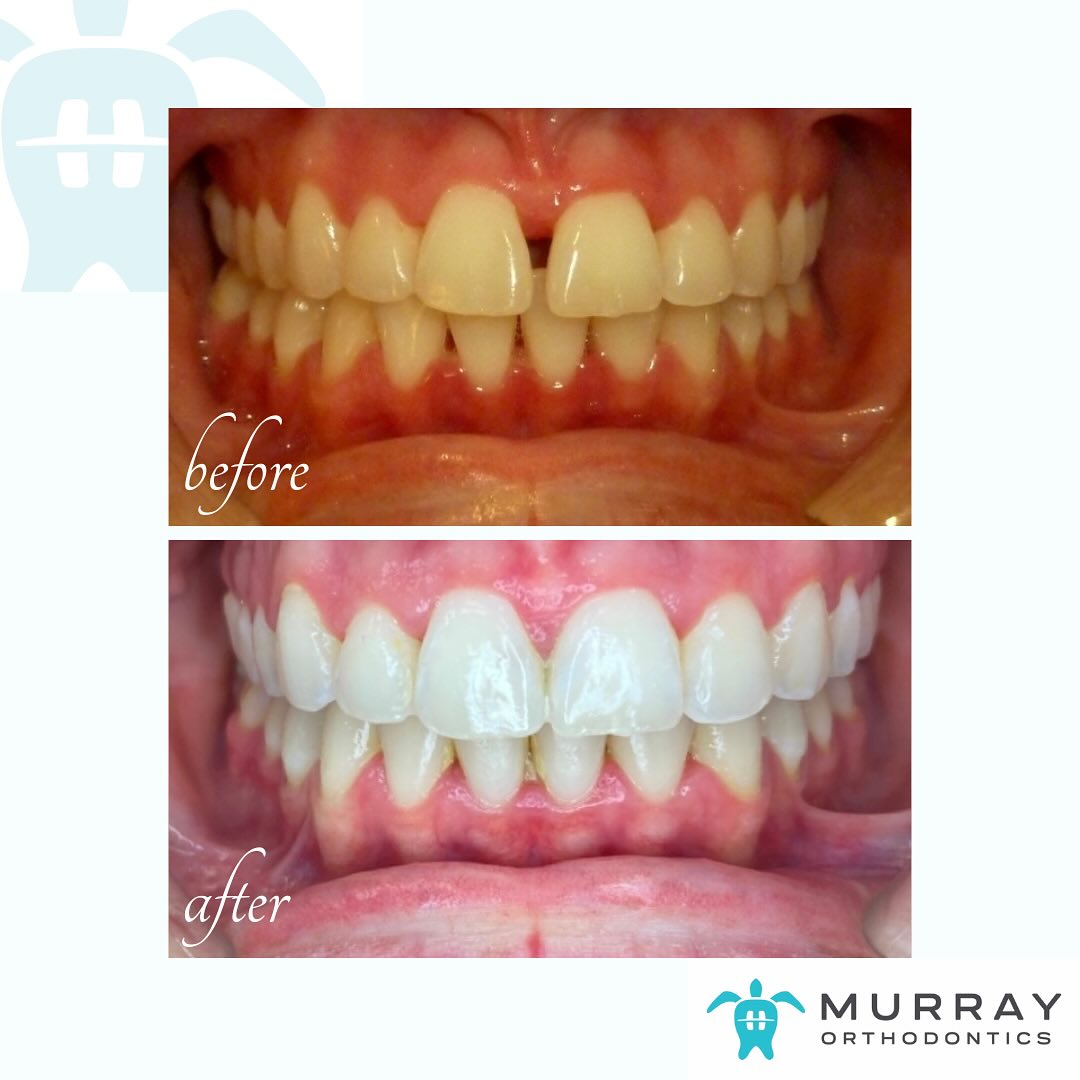

Rainey just finished her Invisalign treatment, just in time to celebrate her sister’s wedding.
How Long Does Invisalign Take for Teens?
Most teens finish treatment in 12 to 18 months, though some simpler cases wrap up faster and more complex ones run longer. The honest answer is that it depends on:
- The complexity of the alignment or bite issue
- How consistently your teen wears the aligners
- Whether their bite needs additional refinement at the end
Check-in appointments are every 8 to 12 weeks, which is less often than the every 6 to 8 weeks needed for braces adjustments. Less time missed from school. Less juggling of your work calendar.
Mild discomfort is normal for the first 3 to 5 days of each new aligner. That is the aligner doing its job, applying gentle pressure to move teeth. Most teens manage it without anything stronger than ibuprofen, and it fades quickly.
How Much Does Invisalign for Teens Cost in Palm Beach Gardens?
Invisalign for teens at Murray Orthodontics ranges from $3,500 to $7,500, depending on the complexity of the case. That is roughly $500 more than traditional metal braces, which run $3,000 to $7,000.
A few things to know:
- The free consultation includes a complete financial breakdown. You will know your insurance benefits, your out-of-pocket cost, and your monthly payment options before you leave.
- We accept more Florida insurance plans than the average orthodontic office.
- In-office, no-interest payment plans are standard. So is a pay-in-full discount.
- We do not quote a flat monthly payment online because every case is different and we would rather give you a real number tied to your real situation.
For a deeper look at orthodontic pricing in our area, see how much braces cost in Palm Beach Gardens, which covers both braces and aligner pricing.
What the First Visit Looks Like
You and your teen come in to either our Palm Beach Gardens office at The Oaks Center or our Royal Palm Beach office. The visit is free and takes about 60 minutes.
Here is what happens:
- Greeted by name by our front desk team, many of whom have been with the practice for years.
- X-rays and photos of your teen’s teeth and bite.
- Dr. Murray personally examines your teen. Not an assistant. Not a treatment coordinator. The orthodontist who will be doing the treatment is the one looking at your teen’s mouth.
- A clear treatment plan with timeline, options, and what Dr. Murray actually recommends. If Invisalign is right, he will say so. If braces would get a better result, he will tell you that instead.
- Complete financial breakdown. Insurance verified, payment options explained, total cost on the table. No surprises.
- Same-day start available if you and your teen are ready to go.
Free, no obligation, and no pressure. Most families come in to compare options, and a lot of them have already visited two or three other orthodontists in Palm Beach County before they get to us.
Why Palm Beach County Families Choose Murray Orthodontics for Invisalign Teen
Board-Certified Orthodontist. Dr. Murray earned his certification from the American Board of Orthodontics, a credential held by a minority of practicing orthodontists. He completed a three-year residency at the University of Florida and has advanced training that includes Invisalign for teens, special needs patients, and dental anxiety.
Top recommended Invisalign provider. Invisalign for teens is one of the most-requested treatments at our practice. We do this every day.
Award-winning care. Three-time winner of Best Orthodontist in Palm Beach County (2023, 2024, and 2026, Palm Beach County Community Choice Awards) and consistently recognized as one of the area’s top orthodontists.
192 five-star Google reviews at our Palm Beach Gardens office and counting. The team’s tenure means your teen will see the same faces every visit, build a relationship, and not feel like a number.
I have had a long relationship with Murray Orthodontics and they never cease to impress! I had the greatest experience for 2 years with braces and now am embarking on my next 6 months with Invisalign. The people working there from the front desk, to accounts, to those in the back, and Dr. Murray have an amazing ability to treat you special and provide you top-notch care!
From Google
Boutique practice, not a corporate chain. Independently owned. Same orthodontist at every visit. Making Palm Beach County smile since 1991.
Two convenient locations. Palm Beach Gardens at The Oaks Center and Royal Palm Beach. We serve families from Palm Beach Gardens, Jupiter, Wellington, Westlake, Greenacres, Loxahatchee, North Palm Beach, and across Palm Beach County.
Find out if Invisalign is right for your teen
Free consultation with Dr. Murray, a Board-Certified Orthodontist. Honest answer, complete cost breakdown, no pressure.
Book your teen’s free visitFrequently Asked Questions
Can my teen drink anything with their aligners in?
Water only. Anything else (soda, juice, sports drinks, coffee) gets trapped against the teeth and can cause decay or stain the aligners. Aligners come out for any other drink, then teeth get rinsed before the aligners go back in.
How often will my teen need to come in?
Every 8 to 12 weeks for check-ins. That is less frequent than the 6 to 8 week schedule needed for braces adjustments. Each visit is short, usually 20 to 30 minutes.
What happens after Invisalign treatment ends?
Retainers, worn nights only right from the start. We will go over fixed and removable retainer options when treatment wraps up.
Is Invisalign Teen as effective as braces?
For most mild to moderate cases, yes. For complex bite issues, severe rotations, or skeletal problems, braces or surgical orthodontics may give a better result. Dr. Murray will tell you which is right for your teen at the consultation.
Can my teen still play their sport with Invisalign?
Yes, and most teens find it easier than braces. Aligners come out for games, replaced with an athletic mouthguard, and go back in after. No brackets to break, no wire emergencies.
How young can a teen start Invisalign?
It depends on dental development, not age. Most teens are candidates once their permanent teeth have erupted, typically around 11 to 13. Younger kids may benefit from a different early-treatment approach. Dr. Murray will assess this at the consultation.
What if my teen does not like wearing the aligners?
If compliance becomes a real problem, we can switch to braces. The conversation is honest and the transition is straightforward. We would rather get your teen a great result than stick with a treatment that is not working.
Does insurance cover Invisalign for teens?
Many Florida dental insurance plans cover Invisalign the same way they cover braces. We will verify your benefits before your consultation so you know exactly what is covered.
Schedule your teen’s first visit
Real exam with Dr. Murray, a complete treatment plan, and a full financial breakdown. About 60 minutes. No pressure to start.
Murray Orthodontics – Royal Palm Beach
685 Royal Palm Beach Blvd #201, Royal Palm Beach, FL 33411
561-795-7707Open Monday through Thursday, 8:30 AM to 5:00 PM.